MSc Dissertation
A mixed-methods research study exploring how groups of sailors plan charter holidays, from pre-trip preparation to real-time coordination at sea, and co-designing solutions for the gap between existing tools.
The Problem
Sailing trip planning is uniquely complex. It spans two distinct phases: pre-trip research weeks before departure, and dynamic re-planning at sea based on weather, crew preferences, and conditions. Sailors juggle pilot books, Navionics, Google Maps, TripAdvisor, and WhatsApp simultaneously, with no single tool connecting the full planning workflow.
Despite this complexity, existing digital tools are designed in isolation: navigation apps handle charts but not itineraries, review platforms cover restaurants but not anchorages, and none support collaborative planning between crew members across multiple boats. The literature confirmed what I suspected from my own sailing experience - no study had involved sailors as co-designers of their own planning tools.
"This has made me realise how difficult it is and I'd be more tempted to pay someone to do an itinerary for me than doing it myself."- Participant 4, during pre-trip planning observation
Research Approach
I designed a four-stage mixed-methods study to capture both phases of planning and move from observation through to actionable design guidelines. Each method built on the last: observations revealed what sailors do, ethnography showed what happens in practice, photo diaries captured what matters emotionally, and co-design sessions turned findings into features.
6 participants · Think-aloud protocol
Observed sailors planning the first three days of a real upcoming trip using their own tools, in their own homes. No tools prescribed or restricted. Captured 80 pages of raw qualitative data across individual and group sessions.
14 participants · 7-day trip · 3 yachts
Joined a week-long charter along the Turkish coast as participant-observer and skipper, documenting how planning actually happens at sea: the coordination between boats, the tools used under pressure, and where communication breaks down.
7 participants · 96 photographs
Asked crew to photograph moments that made them happy during the trip. Post-trip interviews explored what made each location meaningful, revealing categories of place (sunset spots, secluded bays) that no existing tool highlights.
3 co-designers · 3 sessions
Recruited three participants with varied experience to co-create personas, critique conceptual sketches via claims analysis, and generate their own design ideas. They produced 26 new feature ideas beyond the 6 I proposed.
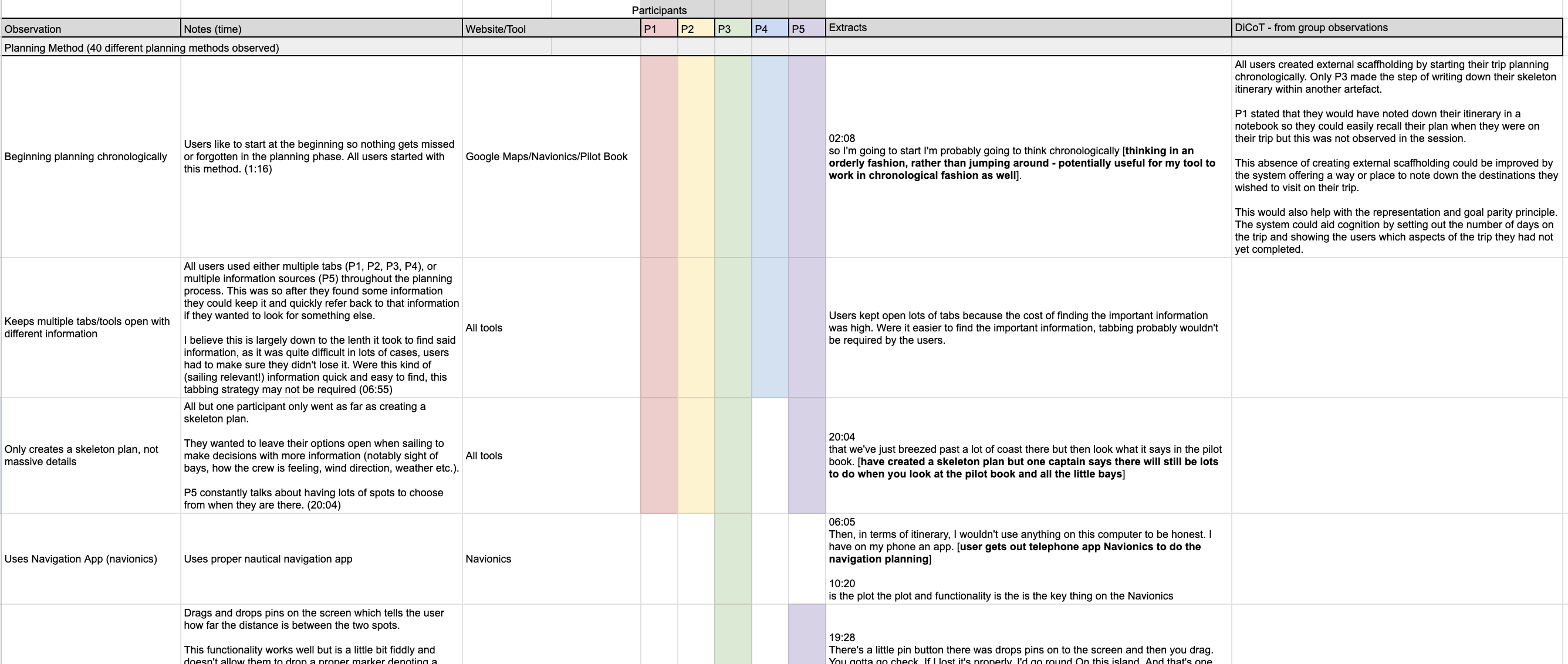
Rainbow spreadsheet - deductive coding of 40 planning methods across participants, with extracted quotes and DiCoT annotations.
Analysis
The ethnographic data was analysed using DiCoT (Distributed Cognition for Teams), mapping physical layouts, information flows, and artefact use across the three boats. This surfaced how planning cognition is distributed across people and tools, and where that distribution breaks down under real sailing conditions.
All qualitative data was then coded through Reflexive Thematic Analysis, combining deductive codes (pre-defined planning methods, challenges) with inductive themes that emerged during a second analysis pass. My own sailing expertise was treated as a resource for richer interpretation, not a bias to eliminate, consistent with Braun & Clarke's reflexive approach.
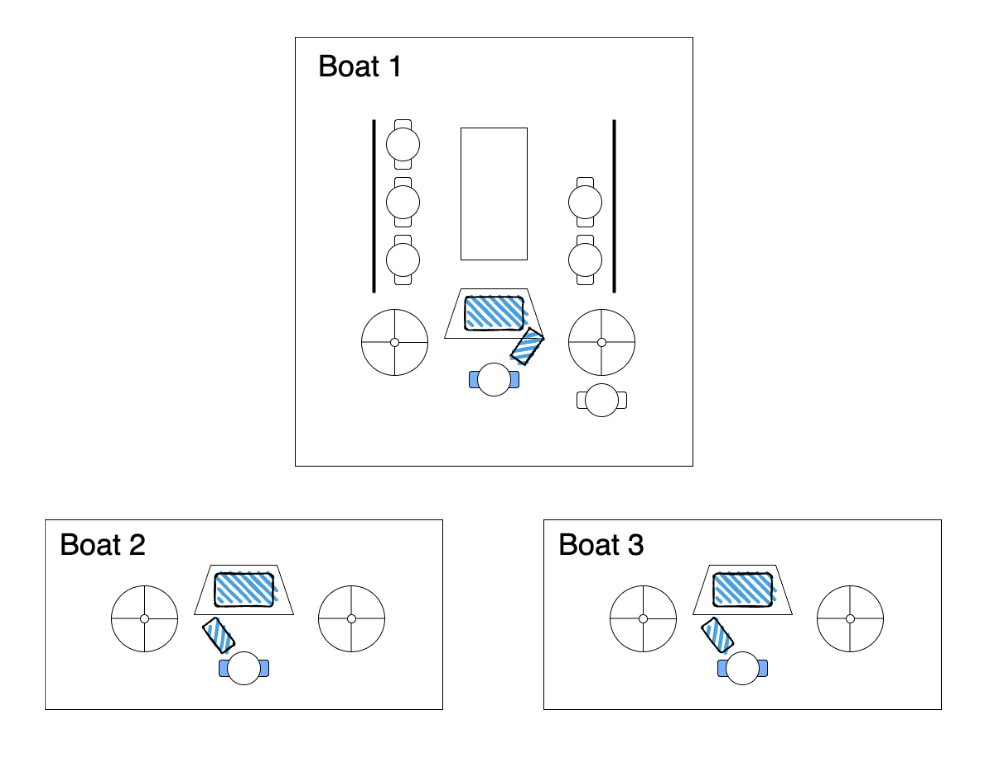
DiCoT diagrams - mapping distributed cognition across boats: physical layouts, information flows, and artefact use.
Key Findings
Moving information between tools is the core pain point. Every participant used three or more tools simultaneously, but finding the same destination across them was consistently difficult. Scale differences between Google Maps and Navionics, inconsistent place naming, and the lack of any shared itinerary layer meant sailors constantly lost context switching between tools. One participant accidentally selected a restaurant 300 miles from their intended location because Google Maps returned results from a different region entirely.
At sea, coordination multiplies the problem. DiCoT analysis of a multi-boat lunch stop decision revealed how planning cognition fragments when skippers can't see each other. One skipper photographed a bay on the B&G chartplotter and sent it via WhatsApp, but unrelated messages immediately displaced it, the zoomed photo made coastline recognition impossible, and the receiving skipper had to hand over the helm to spend minutes scanning the chart for a match. Communication that should take seconds consumed the attention of the person responsible for safety.
Sailors plan in skeleton, not in detail. Participants created loose itineraries with backup options for each day rather than rigid schedules. The recurring theme was needing a Plan B (and C and D) because weather, crew energy, and conditions change constantly. No existing tool supports this flexible, multi-option planning style.
"I use the two in conjunction to work out where it's best to go... this back and forth process adds significant complexity."- Participant 3, on switching between Navionics and Google Maps
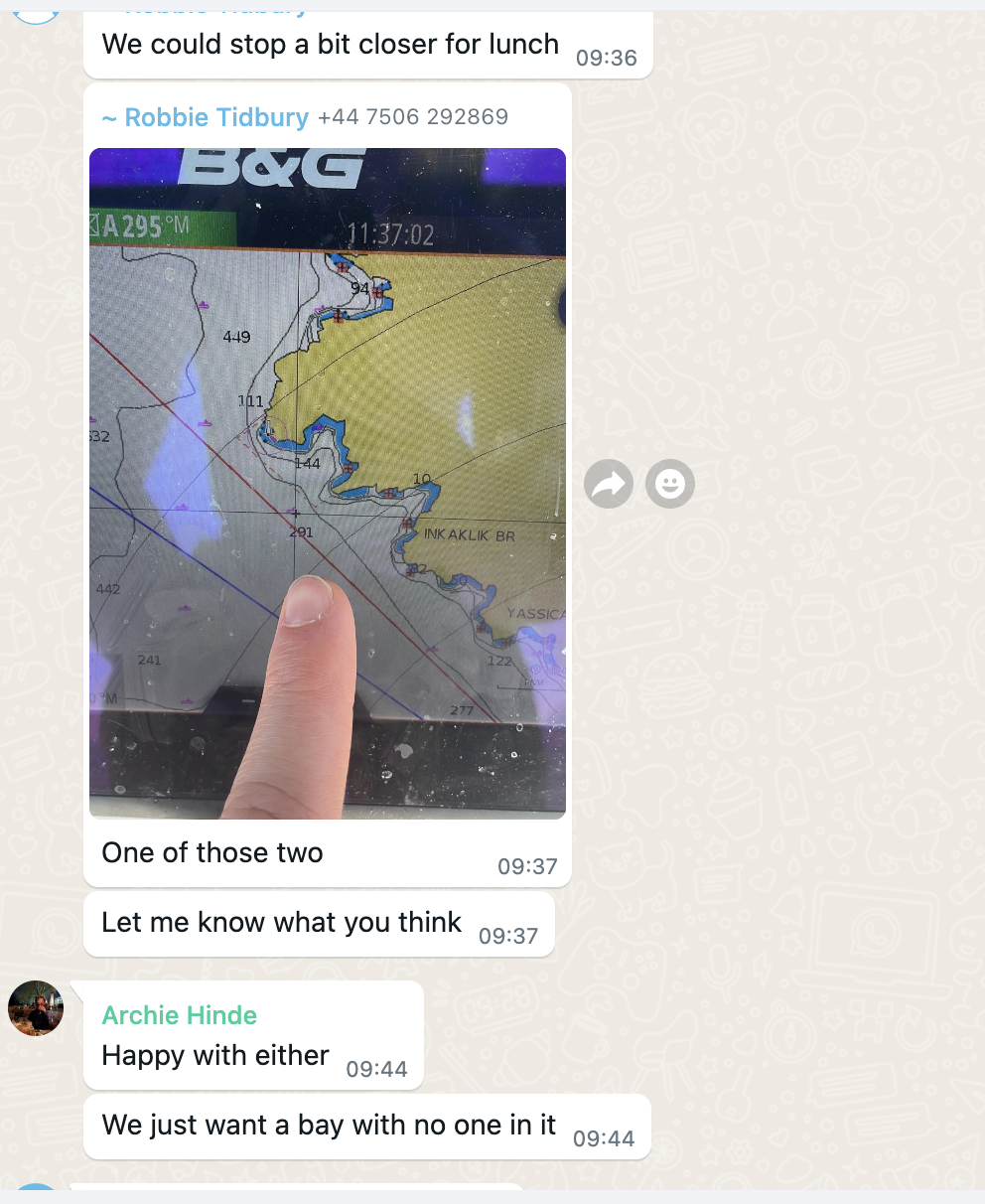
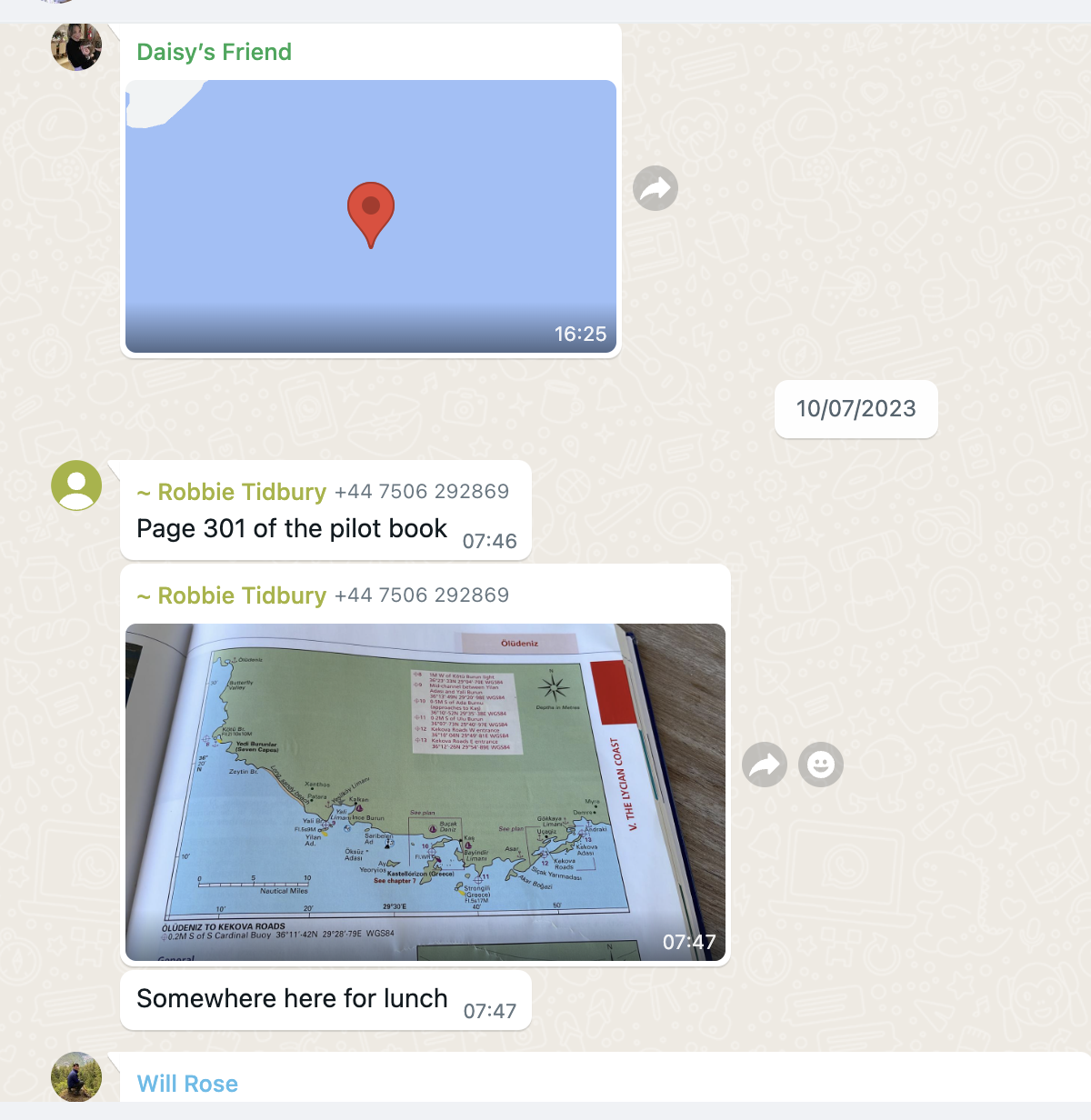
Screenshots from the 7-day ethnographic study - skippers coordinating across boats via WhatsApp, sharing B&G chartplotter photos, pilot book pages, and live locations to agree on destinations.
Co-Design Outcomes
The co-design sessions validated findings while pushing beyond them. Co-designers collaboratively built two personas representing opposite ends of the sailor experience spectrum, then used those personas to critique six conceptual sketches I presented through a modified claims analysis.
The most valuable outcome wasn't the critique of my ideas but what co-designers generated themselves: 26 additional feature ideas grounded in their own experience. Key themes included integrated distance calculators (drop two pins, get nautical miles and sailing time), flexible itineraries that support backup options, shared planning workspaces visible to all crew, and location information combining navigational data with what sailors actually care about: sunset spots, clear water, seclusion.
This was the first study in the sailing domain to use co-design, and the first to co-create personas with sailors, confirming that participatory methods surface insights that observation alone cannot.
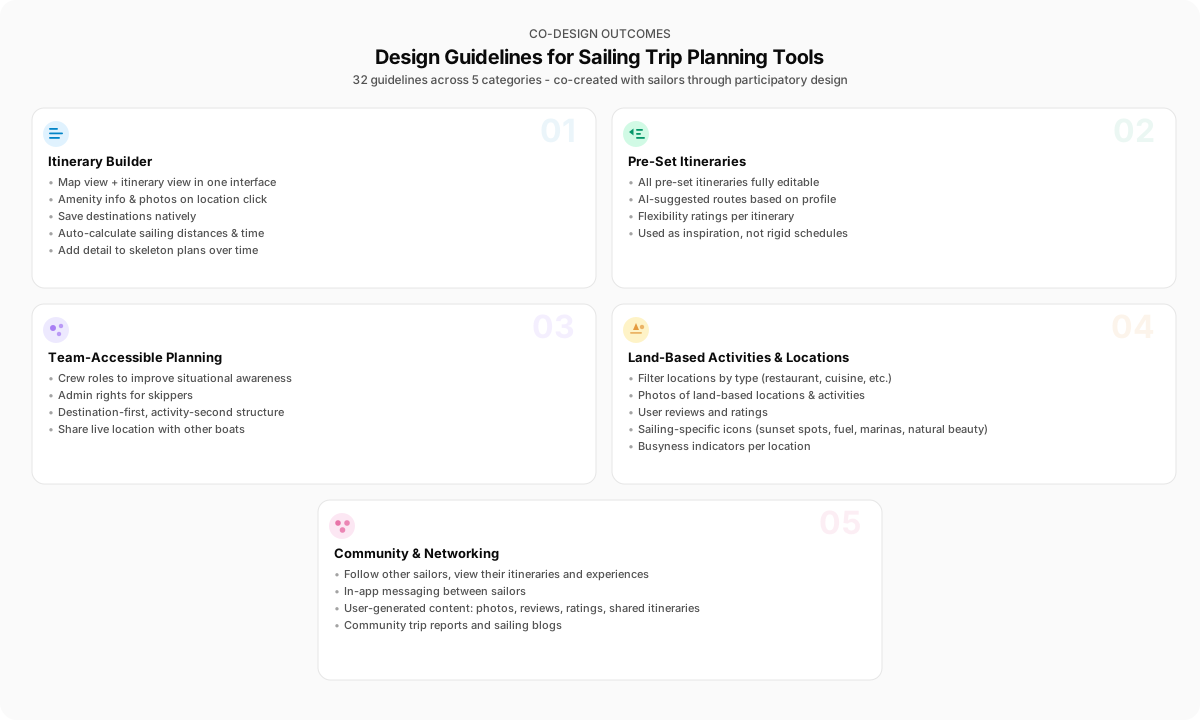
Five guideline categories produced through co-design - combining researcher findings with 26 ideas generated by co-designers themselves.
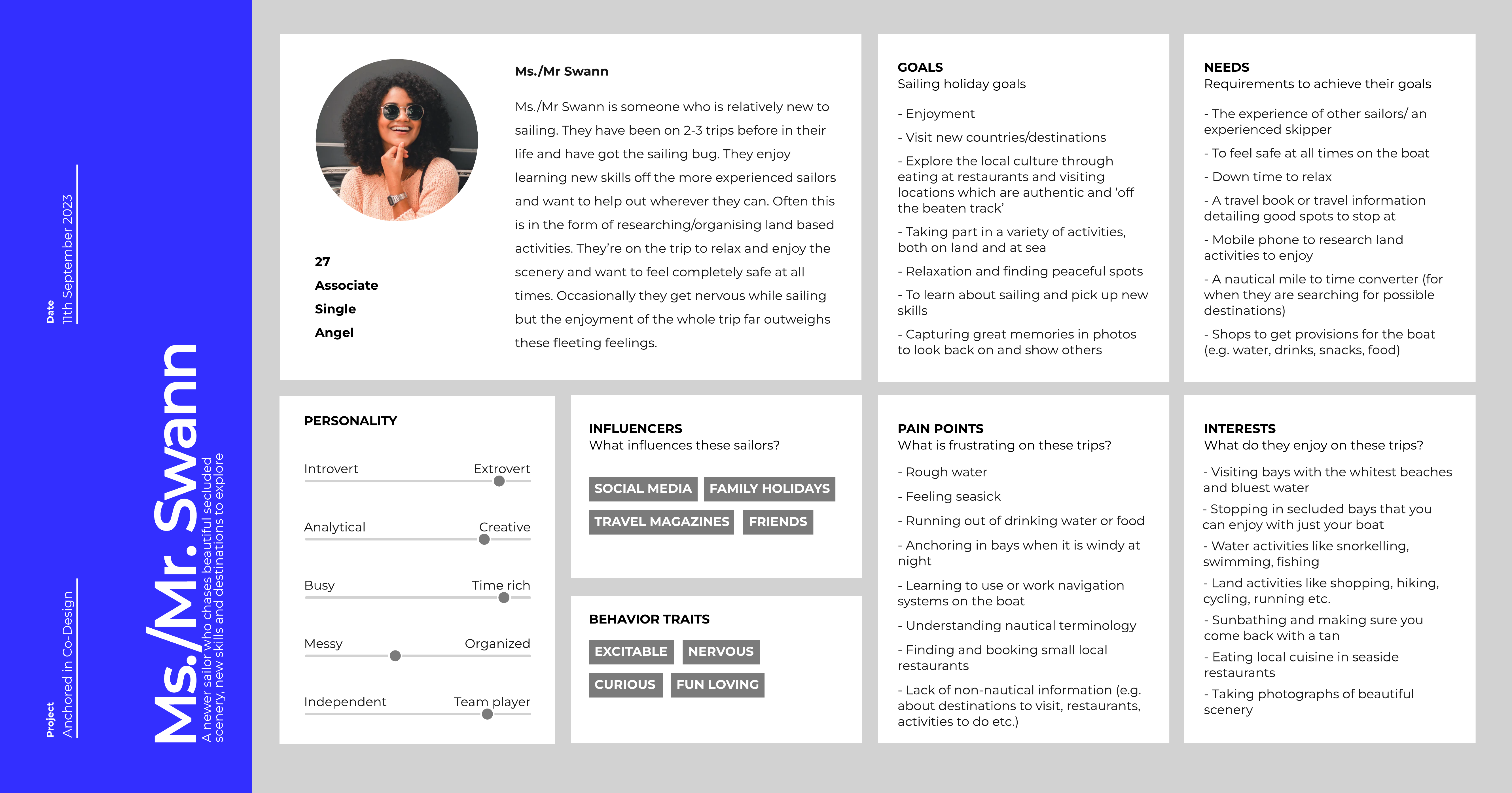
Ms. Swann - one of two personas co-created with participants during the co-design sessions, representing the social, experience-driven sailor archetype.
Reflection
This project taught me the value of being both insider and researcher. My sailing experience gave me credibility with participants, helped me recognise non-obvious behaviours during ethnography, and meant I could conduct the study safely while skippering a yacht. It also required disciplined reflexivity, using my subjectivity as a resource while staying honest about its limits.
The biggest methodological lesson was the power of triangulation. Observations told me what sailors do, ethnography showed me what happens under real conditions, photo diaries revealed what they value emotionally, and co-design let them shape solutions directly. Each method alone would have produced a partial picture, together they built a complete understanding of a problem space no single tool currently solves.